Showing posts with label Homemade Science Challenge. Show all posts

Wednesday, 23 October 2019

Homemade Science Experiment EYFS: Jumping Frogs

JUMPING FROGS – A STATIC ELECTRICITY EXPERIMENT

Have you ever been shocked when you touch your shopping trolley or zapped when you walk on an escalator? This is caused by something called static electricity
Static electricity takes place when energy is stolen from one object and given to another. Balloons and wholly jumpers are two examples of objects which are famous for stealing energy from other objects around them. 

Experiment 1: Crazy hair!

  1. Blow up a balloon (you will need this for the next experiment - so don't pop it!)
  2. Rub the balloon against your hair (the quicker the better)
  3. Look in the mirror! 
This is caused by static electricity. The balloon is stealing charge from your hair causing it stand on end. 

Image result for balloon hair

Main Experiment: Jumping Frogs


JUMPING FROGS – A STATIC ELECTRICITY EXPERIMENt

EQUIPMENT


  1. Balloon
  2. Paper, cut into shapes. We used sugar paper, but tissue paper would also work brilliantly.
  3. Woolly jumper or hair

METHOD

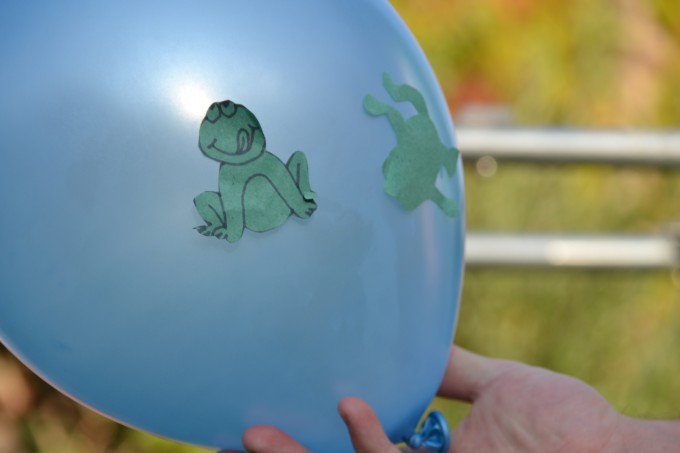
Cut up your different types of paper into frog shapes (or anything else you want to make jump)
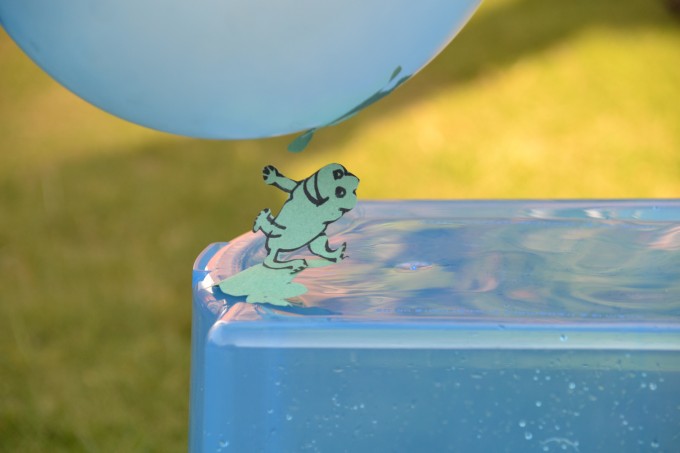
Blow up your balloon, and rub it on your jumper or hair. Hold above the frogs, and watch them jump up.


Static eletricity

HOW DOES THIS STATIC ELECTRICITY EXPERIMENT WORK?

Rubbing the balloon on your jumper or hair, charges it with static electricity, this attracts the frogs making them jump up to the balloon. They will stick until the charge wears off.


Static electricity

MORE STATIC ELECTRICITY EXPERIMENTS

Does it still work if you use normal paper and cardboard?
Can you time how long the frogs stay stuck for?
If you rub the balloon on your hair for longer do the frogs stick for longer?
Do smaller frogs stick for longer than bigger ones?
Try other shapes and themes, like our jumping leaves for Autumn.
Science Kiddo uses static electricity to separate salt and pepper.
Inspiration Laboratories also has a very cool ghost static electricity activity.


Homemade Science Experiment KS1 KS2: Popsicle Stick Catapults

Hello!
This week's Homemade Science Experiment is the Popsicle Stick Catapult!
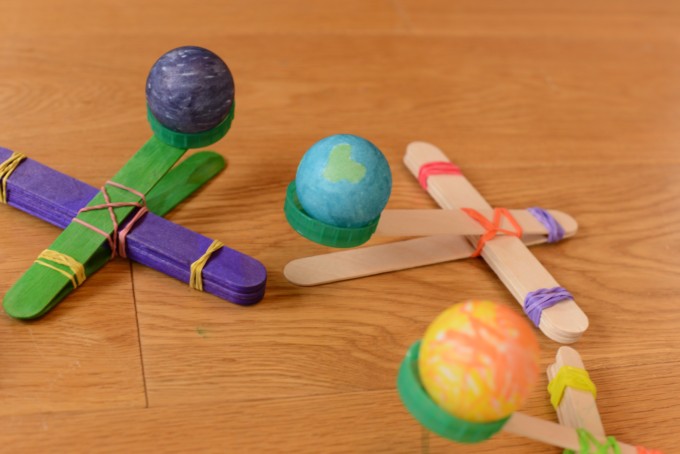
These popsicle stick catapults are very easy to make and provide hours of fun as well as being a brilliant engineering and design project. I've done them before using a space theme and turned the table tennis balls into planets or asteroids but there are so many different catapult designs and themes to choose from, so you can be as creative as you want!
This project is also great for a maths based activity if children record how far different size/weights of balls travel.Maybe they could even conduct some fair testing and discover how the shape of different objects affects how far the catapult can throw them?
Popsicle catapults are very easy to make. Each one takes only a couple of minutes  to build once you get the hang of it.

WHAT YOU NEED FOR A POPSICLE STICK CATAPULT

  • Wide popsicle sticks/ lolly sticks
  • Elastic bands
  • Table tennis balls or other items to test
  • Double sided tape or hot glue
  • Milk bottle top or the head of a plastic spoon
  • Tape measure – optional 

How to make your catapult:
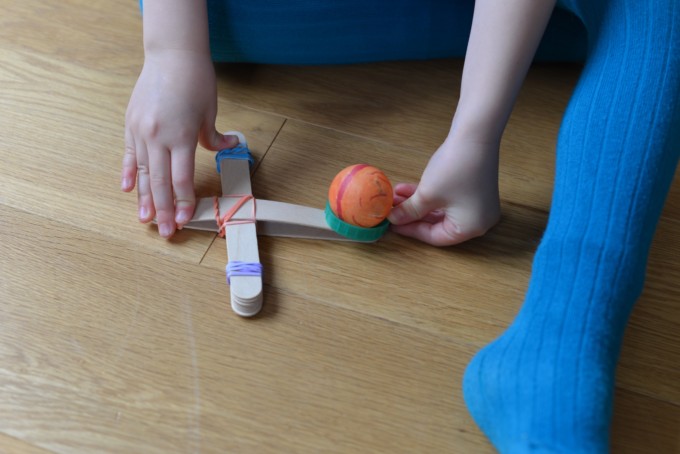
  • Start with about 7 popsicle sticks and place them on top of each other. Twist an elastic band around each end to hold them in place.
  • Place another stick above and one below the stack of 7 so they make a cross shape. There should be more lolly stick on the end you want to use for the milk top.
  • Tie an elastic band around the middle of the cross.
  • Twist another elastic band around the bottom of two sticks as you can see in the photo.
  • Attach a milk bottle top using double sided tape or strong glue.
  • Experiment with your table tennis balls.
popsicle stick craft

POPSICLE STICK CATAPULT INVESTIGATION IDEAS – REMEMBER TO ONLY CHANGE ONE VARIABLE AT A TIME

What happens if you add more or less lollypop sticks to the central core of the catapult?
What happens if your catapult end is shorter?
Does a heavier ball travel further?
How far can you get a ball to travel?
What happens if you make the ball heavier?

***Remember! Send any pictures to the school office under the heading: Re: Mr Wilson - Homemade Science Pictures (along with your child's name and class)
Have Fun!

**NEW** Homemade Science


Hello everyone,

It’s Mr Wilson and I have a new challenge for you!

Moving forward, I will be uploading a new science experiment every two weeks for you to complete at home. 

All of the experiments will be completely voluntary which means you only need to complete them if you really want to. 
These experiments should be completed with parent supervision just to be safe.

If you take any pictures during your experiment, or once you’ve finished, you can email them to the school – just make sure you request the email to be sent to Mr Wilson, under the heading: Homemade Science Pictures along with your name.  

I will select pictures to be included in the future blogs!

Have fun!


Yours sincerely,


David Wilson
Year 4 Teacher